Winter storage is where most golf cart damage happens without anyone noticing. A battery that sits discharged, tires that sit in one spot, and a stereo that quietly draws power for four months all cause trouble that only shows up in spring. Accessories make it more likely, because every added light, speaker or charger is one more thing that can drain the pack or collect moisture.
This plan follows the order you will actually do things: before you park the cart, while it sits, and when you wake it up. Check your owner’s manual and your battery maker’s instructions along the way. Where they differ from the general advice here, follow them.
Clean it, inspect it and check your accessories before it goes away
Wash the cart before it goes into storage. Dirt, dried mud and leaf debris hold moisture against the frame and the wiring, and a cart that sits dirty for months will have corrosion to deal with in spring. Rinse the underbody gently and keep water away from the motor, the controller and any open electrical connections. Dry the cart completely, including the seams of the seats, before covering it.
Clean the seats and floor mat with a cleaner suited to vinyl, then let them dry fully. Food crumbs and sweat attract mice, and a cart that has been parked for winter makes a good nest.
Once it is clean, walk around the cart and look for things to fix now rather than in March:
- Tires: check for cracks, nails and low pressure. If you added larger tires with a lift kit, check them closely, since they cost more to replace.
- Brakes and cables: look for frayed cables and fluid leaks, and listen for grinding on your last drive.
- Wiring: look for chafed insulation, loose connectors and corroded terminals, especially around anything you added yourself.
- Frame and hardware: check bolts on lift kits, seat brackets, rear flip seats and roof supports.
Deal with your accessories
Accessories need their own pass, because many are wired to the battery in ways the factory never planned for. Lights, sound systems, USB ports, dash cameras and GPS units can all draw a small current even when the cart is switched off. Over a winter, that current can run a battery flat. The LED light kit and battery drain article explains how much load different lighting setups put on a pack while the cart is running.
Before storage, do the following:
- Switch off every accessory at its own switch, then confirm the cart’s main switch is in the off or tow position.
- Remove portable items: speakers, phone mounts, cameras, cup holder chargers, cooler racks with electronics and anything else that comes off without tools.
- Disconnect the main negative battery lead if you have accessories wired directly to the pack, or if you cannot tell whether they draw power when off.
- Take off or loosen soft enclosures. A sealed vinyl enclosure traps humidity, and mildew will grow on the seats and the inside of the panels. If you leave it on, leave a gap for air to move through.
If you have a gas cart, add fuel stabilizer to a nearly full tank, run the engine for a few minutes so the stabilized fuel reaches the carburetor or injectors, and change the oil before storage so used oil does not sit in the engine all winter.
For a fuller list of what a cart needs across the year, the golf cart maintenance checklist covers the routine items this guide leaves out.
How to charge a golf cart before storage and through the off-season
Charge the cart fully before you park it for winter. A discharged lead-acid battery sulfates, which permanently reduces its capacity, and a discharged battery freezes at a much higher temperature than a charged one. A full charge is the single most useful thing you can do for a stored pack.
The correct routine depends on your battery type.
Flooded lead-acid batteries
These are the batteries with removable caps and liquid electrolyte. Check the water level in every cell before the final charge. If the plates are exposed, add distilled water until they are just covered, then charge. Tap water leaves mineral deposits on the plates. Do not fill to the brim before charging, because electrolyte expands as it heats and can overflow, so top up to the proper level after charging if the cells are still low.
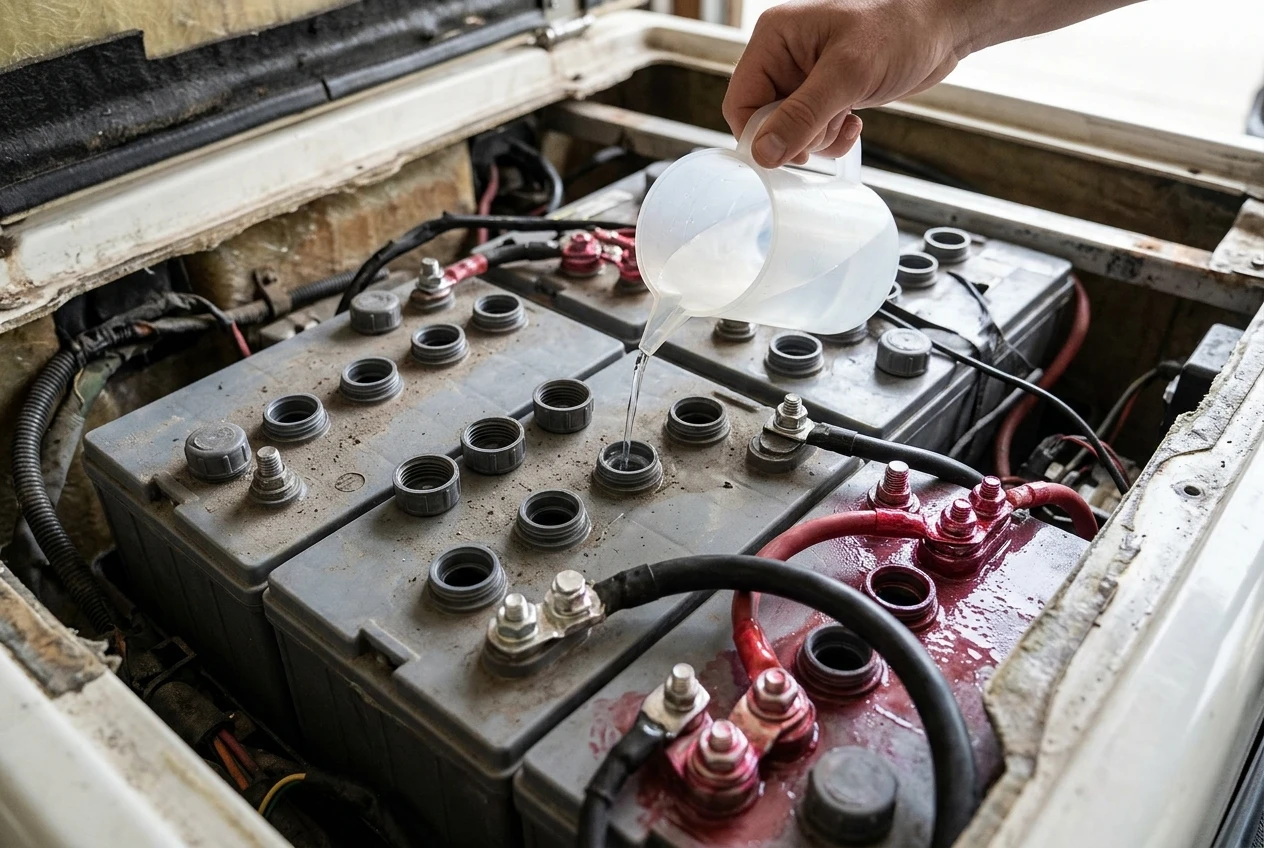
Clean the terminals with a baking soda and water solution and a brush, rinse lightly, dry them, and coat them with terminal protectant. A fully charged flooded pack still loses charge while it sits. Plan to recharge it about once a month, or leave a charger connected only if it is an automatic one that switches to maintenance mode and your manual says that is fine.
Sealed AGM and gel batteries
These need no watering, but they discharge in storage just like flooded ones and must be topped up on a schedule. Use a charger with a profile matched to the battery type, because a charger set for flooded batteries can damage AGM or gel.
Lithium batteries
Lithium packs have a built-in battery management system and lose charge much more slowly in storage. Manufacturers often give a specific storage charge level, which is not always 100 percent, along with a limit on how long the pack can sit before it needs attention. Follow the maker’s instructions. If you own a lithium conversion, the battery upgrade guide is the place to compare what different packs need.
General charging rules for the off-season
- Use the charger that came with the cart or one made for your battery’s voltage and chemistry.
- Never leave a basic charger without an automatic shutoff plugged in for months.
- Charge in a ventilated place, because flooded batteries release hydrogen gas while charging.
- Write the date of each charge on a card and keep it on the cart. By January you will not remember whether the last one was in November or December.
How long golf cart batteries last, and what a neglected winter can do to them
Battery lifespan varies widely with chemistry, age, how deeply the pack is discharged, how well it is maintained and how it is stored. Flooded lead-acid packs last a number of years with regular watering and charging. Lithium packs generally last longer, which is part of why they cost more up front. The 2026 golf cart battery guide compares the types in detail.
Winter storage matters because a lead-acid battery rarely fails suddenly. It loses capacity a little at a time, and a bad winter is when a good amount of it goes. Three things cause most of the damage.
Sulfation. A lead-acid battery that sits partly or fully discharged develops hard sulfate crystals on its plates. Light sulfation can sometimes be reversed with a slow charge. Heavy sulfation cannot, and the battery will hold less charge from then on.
Freezing. A fully charged battery handles cold well. A discharged one has weaker electrolyte and can freeze, which cracks the case and ruins the cell. This is a real risk in an unheated shed in a cold climate.
Self-discharge and parasitic draw. Even a healthy lead-acid battery loses charge when it is idle, and warmer storage speeds that up. Add a stereo or LED controller that never fully shuts off, and a pack can be flat within weeks.
You can see the effect in spring. If the cart used to travel a certain distance and now runs out much sooner, or the voltage sags noticeably under a hill, the pack lost capacity over the winter or before it. Test each battery’s voltage individually. A single weak battery drags the whole pack down and is often the cheapest fix.
Where to park it: garage, shed or covered outdoors
The best place is a dry, enclosed building where the temperature stays above freezing and the cart is off the ground floor moisture. An attached or heated garage is ideal. An unheated garage or shed works if you have kept the batteries charged and the temperatures do not go far below freezing for long stretches.
Outdoor storage is the weakest option, but it can be done if you have no alternative. Use a breathable, fitted cover rather than a plastic tarp, which holds condensation against the cart and promotes mildew. Park on a hard, level surface, not on grass or bare soil, and keep the cart away from places where water runs or pools.
Whichever place you use, handle these points:
- Tires: inflate to the maximum pressure printed on the sidewall to reduce flat spots, and check the pressure once during the winter. For a long stay, jack stands under the frame take weight off the tires, which is worth doing if you run expensive wheels and tires.
- Parking brake: on a long stay, the brake pads can stick to the drums. Chock the wheels instead of relying on the brake alone if your manual allows it.
- Rodents: mice and rats chew wiring insulation, and a chewed harness is a costly repair. Close gaps where you can, set traps nearby, and look under the seats and in the battery compartment for nesting material.
- Ventilation: a closed space with batteries needs some airflow. A cover that touches the cart everywhere, in a room with no air movement, invites mildew.
Keep the cart off a floor that is damp or that floods. Concrete wicks up moisture, so a pallet or rubber mat under the tires helps.
How much a golf cart costs and what yours is worth after a winter in storage
New and used prices vary a great deal by brand, model, battery type and what is installed, so any single figure would mislead you. The golf cart prices by brand comparison lays out how Club Car, E-Z-GO, Yamaha, Icon and Evolution differ.
What matters for storage is that resale value follows condition. Buyers look at the age and state of the batteries, the body and seats, the tires, and whether the cart starts and runs cleanly. A cart stored properly keeps its seats free of mildew, its wiring free of rodent damage and its batteries in good shape. A cart left to sit dirty, discharged and uncovered loses value in all of those areas, and a new battery pack is one of the largest single repairs a seller faces.
Accessories are a separate question. Lights, a sound system, a lift kit and custom wheels make the cart yours, but they rarely return what you paid when you sell. Some buyers want them and others see them as modifications to undo. Keeping the original parts you removed, and keeping receipts and manuals, makes a cart easier to sell. For that reason, store any removed accessories somewhere dry and labeled so they stay in working order.
How fast a golf cart goes, and why a speed check belongs in your spring start-up
Most standard carts are set at the factory to run at a moderate speed, in the range of a bicycle at a brisk pace up to a bit faster. Gas and electric models differ, and so do models with speed controllers or special settings. Carts sold as low-speed vehicles can reach up to 25 mph, which is the legal ceiling for that category in the United States.
Speed matters in spring because several things that happen over winter change it:
- Tire pressure: low tires reduce speed and range and increase wear.
- Battery condition: a weakened pack sags under load, so the cart feels slower, especially uphill.
- Brakes: a cart that has sat may have rusted drums or sticky pads, which affects stopping at any speed.
- Modifications: larger tires from a lift kit raise the real speed above what the speedometer or controller setting suggests, and they lengthen stopping distance. The lift kit installation guide covers fitting; afterward, check your brakes and speed rather than assuming nothing changed.
On your first drive, find a flat, empty stretch and check the cart at low speed, then at its normal cruising speed. Brake firmly a few times. Listen for new noises. If the cart pulls to one side or the brake pedal feels soft, fix it before using the cart around other people.
Are golf carts street legal, what is the speed limit and do you need a license
This depends on where you live, so check with your state motor vehicle agency and your local government. In general, a standard golf cart is built for courses and private property. Many communities allow carts on certain local roads, and some neighborhoods are set up for them. A cart that can legally use public roads in most states has to meet the federal rules for a low-speed vehicle.
A low-speed vehicle typically needs:
- A top speed between 20 and 25 mph
- Headlights, tail lights, brake lights and turn signals
- Reflectors and a rearview mirror
- A windshield
- Seat belts
- A vehicle identification number
- A parking brake
Many states limit low-speed vehicles to roads with posted limits of 35 mph or lower. A driver’s license is usually required for road use, and registration and insurance are common requirements as well. Rules differ on whether a plain golf cart needs any of these, and on the age at which someone can drive one. Do not assume that a rule from another state applies to you.
This ties into storage in two practical ways. If your cart is street legal, registration, insurance and inspection dates may fall during winter, so check them before you park it. In spring, test every light, turn signal, mirror and the horn. An accessory lighting kit that was switched off or disconnected for the winter may not be working when you reconnect it, and a cart with a failed brake light is not road legal.
Your spring start-up checklist, and where to look if it won’t start
Work through the cart in this order, which keeps small problems from turning into bigger ones.
- Look it over. Check for nests, chewed wires, leaks, mildew and anything that moved during winter.
- Reconnect the battery. Clean the terminals again, tighten the connections and check that cables are not cracked.
- Check water levels in flooded batteries and fill with distilled water if needed.
- Charge fully and note whether the charger completes its cycle normally. A charger that never finishes can point to a failing battery.
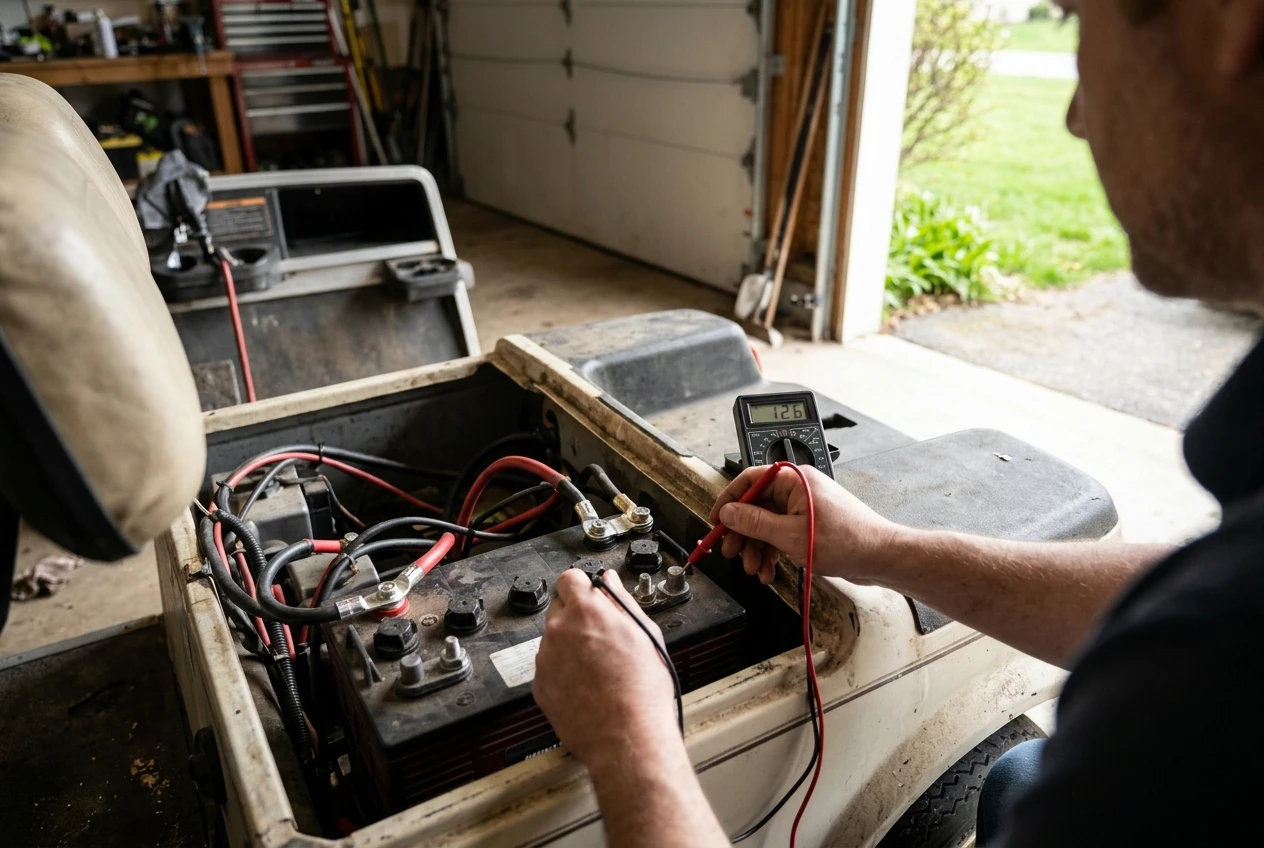
- Test each battery’s voltage and compare. One much lower than the others is the weak link.
- Inflate the tires to the pressure your manual specifies and inspect the sidewalls.
- Test the brakes and the parking brake before you drive.
- Put back your accessories and test each one: lights, signals, sound system, USB ports and anything wired to the pack.
- Take a short, slow drive on level ground before heading anywhere that matters.
On a gas cart, replace the spark plug if it looks worn, check the oil and fuel lines, and expect it to crank a bit longer on the first start.
If it won’t start
Check the simple things first: the key switch, the forward and reverse selector, the tow or run switch, the battery connections and the charge level. Many failures come from a loose terminal or a flat battery rather than from a failed motor or controller. The golf cart won’t start guide walks through the checks in the order that saves the most time before you call a shop.
If you added accessories this season, see golf cart accessories for 2026 before buying anything else, so any new additions suit the pack you have and the winter plan you just followed.