If you have already priced the lift kit and tires, you have the part of the build everyone prices first. The parts cost adds up in the purchases you have not planned yet: seat covers become new seats, a light bar needs wiring, a speaker needs a place to mount and a way to be powered. This article walks through budgeting the whole build before you spend more, so the final total matches the number you started with.
Why the lift kit and tires were never the real budget
A lift kit and a set of tires are the first things most builders search for, so they are the first prices a builder knows. They also look like the whole project, because they change how the cart looks and sits.
The rest of the build gets decided later, one small purchase at a time. A seat upgrade here, a set of lights there, a stereo once the cart is already on the road. Each decision feels small next to the lift kit, so none of them gets added to the running total. Months later the receipts are a pile, and the cart has cost far more than the number you started with.
A budget built around the headline parts only covers the parts you thought of first. A build budget covers every part the finished cart will have, including the ones you have not chosen yet.
The parts that quietly double a build: seats, lights and a stereo
Seats, lights and a stereo are where most overruns start, for a plain reason: each one pulls in other purchases.
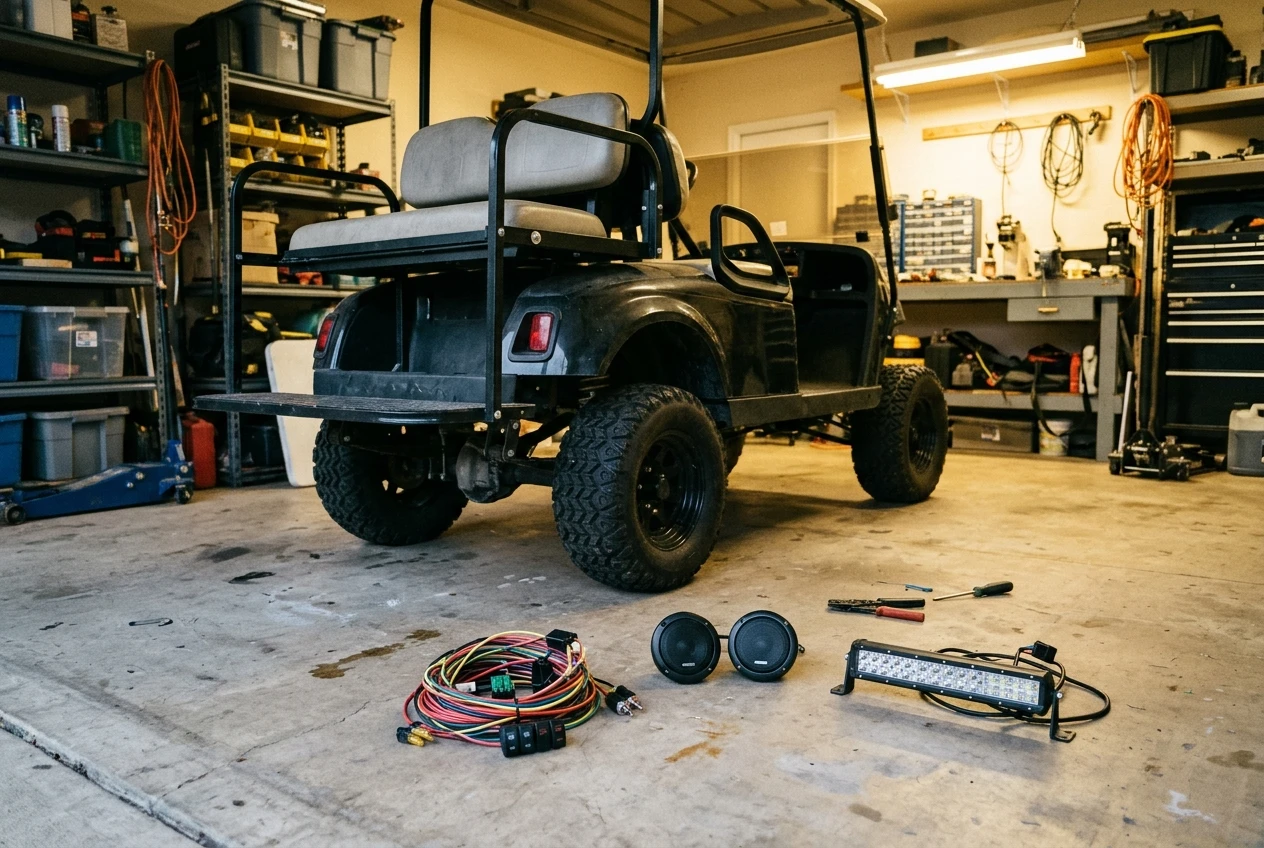
- Seats. A new seat set can mean new mounting hardware, and a rear flip seat is a different purchase from a standard one. If the cart is lifted, check whether the new height changes how people climb in, because a step or grab handle may belong on the list too.
- Lights. The kit is only the start. Wiring, switches, fuses and mounting brackets may be sold separately. If the cart’s battery pack voltage is higher than the lights are rated for, you may also need a converter. Our piece on whether LED light kits drain golf cart batteries faster covers the power side in more detail.
- A stereo. Speakers, a head unit or Bluetooth receiver, an amplifier if you want volume, wiring, and an enclosure or mounting location. Each can be priced on its own, and the total depends on how many of them you want.
None of this means skipping these parts. It means giving each one a full line on the list before the first purchase, with everything it needs to work, not just the item you picked.
Write the whole parts list before you buy anything
Open a spreadsheet or a notebook page and write every part the finished cart will have. Start with the big items you have already priced, then walk around the cart in your head: wheels, tires, suspension, seats, lighting, audio, body, steering wheel, storage, mirrors, windshield, charging and battery.
For each line, write four things:
- The part itself.
- Everything else it needs to be installed and to work (hardware, wiring, adapters, tools you do not own).
- The price you have found, or a clear note that you have not priced it yet.
- Whether it is a replacement for something the cart already has.
The unpriced lines matter most. Each one is a place where the total could move, so the list shows you how much of your number is solid and how much is a guess. Spend an evening pricing those lines before you spend anything on the build.
If you are still deciding what the cart itself should cost before you start modifying it, our comparison of golf cart prices by brand is a useful companion to this list.
Then add a buffer line. Choose a percentage of the total that you are comfortable setting aside for things you did not predict, and write it in as its own row. A budget with a buffer in it can absorb a missing connector without going over.
Sort every part into must-have, do-later and skip
Once the full list exists, assign each line to one of three groups.
Must-have parts are the ones the cart needs to be safe and usable the way you intend to use it. Tires that fit the wheels, anything that keeps the lifted cart stable, working brakes and basic lighting if you drive on roads or at dusk.
Do-later parts improve the cart but do not stop it working without them. A stereo, accent lighting, upgraded seat covers and storage accessories often land here. These stay on the list with a price so the total stays honest, but they are bought after the must-haves are done.
Skip parts are the ones you wrote down because they looked good on someone else’s cart. Be strict about this group. If a part does not serve how you actually drive the cart, take it off. Skipped parts are the cheapest savings available, because the cart loses nothing you would have noticed.
Sort by use, not by price. An expensive part can be a must-have, and a cheap one can be a skip. The point is that every purchase has a reason on paper before it has a charge on your card.
Buy in an order that lets you stop at any point with a working cart
The order you buy in decides how a budget problem feels. If money runs short halfway through a build and the cart is on jack stands with no wheels, you have a project stuck in the garage. If the money runs short and the cart is finished through stage two, you have a working cart and a shorter wish list.
A sequence that tends to hold up:
- Safety and structure first. Suspension, wheels and tires, and brakes, bought together where parts depend on each other. A lift and the tires it is meant to carry should be planned as one stage. Our walkthrough on installing a golf cart lift kit in one weekend can help you judge what that stage involves.
- Power and wiring next. If lights and audio will be added, any shared wiring, fuse blocks or battery work should be settled before the accessories that draw from them. Doing it once is cheaper than redoing it. Read our 2026 golf cart battery guide if you are unsure the pack can handle the extra load.
- Seating and comfort. Seats and any step or grab handle that the new height requires.
- Lighting. Once the power side is ready.
- Audio and cosmetics last. These are the easiest to postpone and the easiest to over-spend on.
After each stage, the cart should drive, stop and be safe to use. That is your stopping point if the budget has moved.
Where you can trim without wrecking the result
Trimming is easier when it is planned. Some places where cuts usually cost little:
- Cosmetic parts. Seat covers, steering wheel wraps, and decorative trim can be a simpler version of what you first chose without affecting how the cart works.
- Do-later parts you never come back to. If a part has sat in the do-later group for several months and you have not missed it, move it to skip.
- Duplicates. Check that you are not buying two parts that do the same job, such as a bundle that includes lights you have already bought separately.
- Labor you can do yourself. Many installations are within reach of someone with basic tools. Check the instructions and the tools involved before deciding, and pay for a shop only where the job really requires one.
- Bundles. A package can lower the total when it includes only parts already on your must-have list. A bundle containing parts from the skip group is not a saving.
Some things are poor places to cut: brakes, tire and wheel fit, wiring quality and fuses. Those are the parts where a cheap choice gets expensive later, either through a repair or a safety problem.
How to check each new part against your original number
Keep the list open as a running record. When you are about to buy something, run it through four checks:
- Is it on the list? If not, add it with everything it needs, then see what it does to the total.
- Is the price within the line you wrote? If it is higher, note the difference and decide where the extra comes from.
- Does it add other purchases? Mounting hardware, adapters and extra wiring belong on the list before you click buy.
- Does it change the order? A part that depends on another stage may belong later in the sequence.
For anything not on the list, wait a day or two before buying. Unplanned purchases are the ones that move the total, and a short wait removes most of them. When something genuinely earns its place, swap it for a lower-priority part so the total holds.
Update the spreadsheet with the real price after every purchase, not the price you expected. The gap between planned and actual on each line will show you early whether the build is on track.
Your next step
Before you buy your next part, write your full parts list and sort it into must-have, do-later and skip. Then browse the related guides on this site for the parts you’re still weighing: golf cart suspension upgrades and what actually changes the ride, whether LED light kits drain the battery faster and premium marine-grade speakers for golf carts.